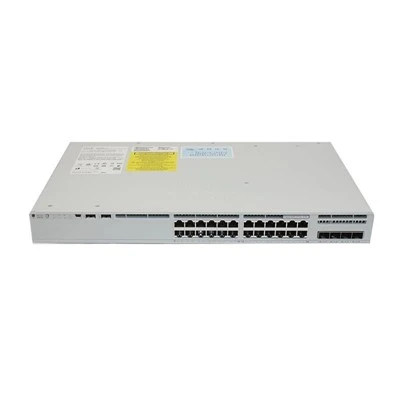

Cisco switches, designed and deployed by Cisco Systems, are core networking devices built around the requirements of high-performance data forwarding and stable operation. Their architecture features clear modularity and layered design, providing an efficient and reliable foundation for modern networks.
From a system perspective, a Cisco switch is generally composed of three main components: a control unit, a switching unit, and interface modules. The control unit handles device management and protocol processing, including system operations, configuration tasks, and network protocol interpretation. The switching unit serves as the core component, typically implemented with dedicated ASIC chips responsible for high-speed data forwarding. The interface modules connect the switch to external devices and provide various physical ports such as Ethernet and optical interfaces.
In terms of architecture, Cisco switches adopt a separation between the control plane and the data plane. The control plane is responsible for learning network topology, building forwarding tables, and executing management policies, while the data plane focuses on fast packet forwarding. This separation significantly improves processing efficiency and reduces system load, allowing the switch to maintain stable performance under heavy traffic conditions.
At the hardware level, Cisco switches widely use ASIC-based acceleration technology, enabling most forwarding operations to be executed directly in hardware. This reduces reliance on the CPU and greatly enhances forwarding speed and response efficiency. In higher-end models, multi-chip parallel architectures are also used to support greater bandwidth and large-scale data processing requirements.
Regarding port and expansion design, Cisco switches typically offer multiple interface types and support modular expansion. Users can add uplink or optical modules according to network requirements to adapt to different deployment scenarios. In addition, stacking technology allows multiple switches to operate as a single logical device, simplifying management and increasing overall capacity.
For reliability, Cisco switches are often equipped with redundant power supplies, cooling systems, and link backup mechanisms to ensure continuous operation even in the event of hardware failure. This high-availability design enables them to meet the strict stability requirements of enterprise and data center environments.
Overall, through modular hardware architecture, separated processing planes, and high-reliability design, Cisco switches achieve a balance of performance and stability, providing a solid foundation for complex networking environments.